Insights
Kenya’s Hunger Regression: What Kenya’s New Global Hunger Index Ranking Really Means
Africa Research Institute, Understanding Africa Today 310
310
 1200
627
310
310
ARI is grateful to Oscar Ochieng and the Institute of Economic Affairs for their kind permission to republish this blog in abridged form. It was first published on 11 November 2025, but its relevance has been accentuated by the consequences of the Iran war.
Kenya is slowly sliding back to poverty levels last seen in the early 2000s. According to Kenya National Bureau of Statistics (KNBS), the national poverty rate rose from 33.6% in 2019 to 39.8% in 2022, reversing over a decade of progress and pushing towards the 46.8% figure of the early 2000s. This regression underlines that Kenyans may be poorer today than during COVID‐19. While the government insisted inflation was ‘down’ in 2025, the lived reality suggests otherwise. Households still cannot afford enough food. The national food poverty headcount is 31.7%, meaning over 16 million Kenyans are unable to meet the minimum food consumption threshold.
In October 2025, Kenya’s overall inflation rate stood at 4.6%. The biggest drivers of the increase were Food and Non-Alcoholic Beverages at 8.0% and Transport at 4.8%. Housing, Water, Electricity, Gas and other fuels rose by 1.9%. These three categories account for over 57% of the household expenditure weighting in the inflation basket. In other words, despite the seemingly low inflation rate, the perception remains that the cost of food, in particular, is high and still rising.
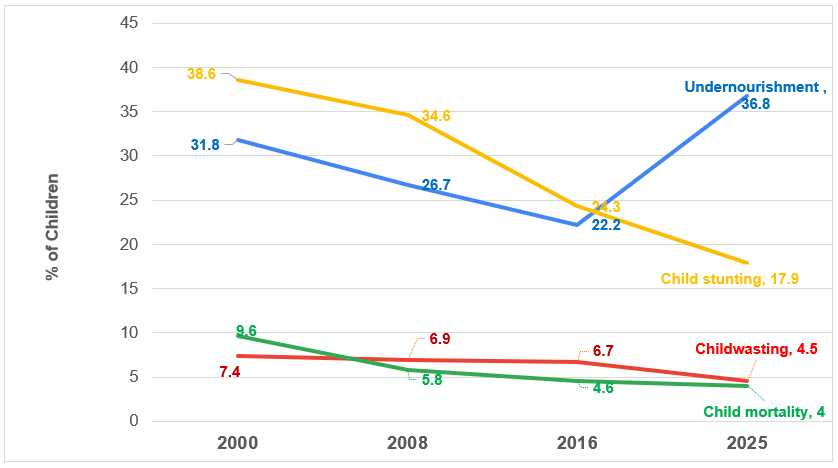
The Global Hunger Index (GHI) reveals a stark deterioration in Kenya’s food security position. The country ranks 103 globally, with 36.8% of the population undernourished* by the GHI measure. This is the highest level in 25 years, and an increase of 14.6 percentage points since 2016. It is categorised as ‘extremely alarming’ alongside five other countries in sub-Saharan Africa – Democratic Republic of Congo, Liberia, Madagascar, Somalia and Zambia. This is a serious indictment of policy for a lower-middle-income country.
Figure 1: Kenya’s Global Hunger Index Scores 2000-2024
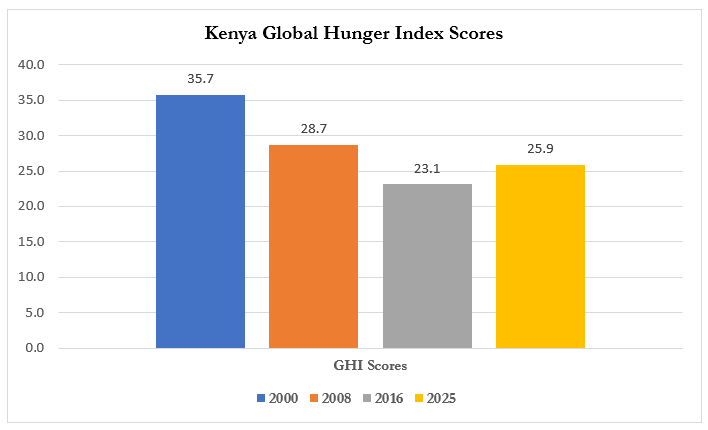
*The four components of the GHI score are undernourishment (1/3 of total), child stunting and child wasting (each 1/6 of total) and child mortality (1/3 of the total)
Kenya’s overall GHI score stands at 25.9, bracketing the country between low-income Ethiopia and Mozambique in the ‘serious’category. Between 2000 and 2016, Kenya steadily reduced hunger levels through enhanced nutrition programmes, improved health services and agricultural expansion. Child stunting dropped from 38.6% to 17.9% and child mortality rates halved. However, the latest data signalled a materially worsening hunger crisis.
The 2025 GHI report attributes Kenya’s setback to prolonged droughts, high food prices, and declining household purchasing power. Between 2019 and 2023, the country experienced six consecutive failed or below-average rainy seasons, severely damaging crop and livestock production in arid and semi-arid regions. The report noted that ‘the climate crisis is no longer episodic; it has become a constant threat. 2024 was the hottest year on record, and extreme weather events are increasingly devastating food systems.’
Economic pressures have worsened access to food. As Amartya Sen argued in his book Poverty and Famine: An Essay on Entitlement and Deprivation, famines can occur even when food is available because people lack the purchasing power to buy it. Kenya’s Poverty Report 2022 recorded a hardcore poverty rate of 7.1%, meaning that over 3.6 million people lived in conditions of abject poverty, unable to afford the minimum required food consumption basket even if they allocated all their food and non-food expenditures to food alone. Similarly, a study by UN agencies found that the cost of a healthy diet rose from KSh.113.86 (US$0.87) per person per day in 2017 to KSh.189.48 in 2024. An adequate and nutritious diet is increasingly beyond reach for many Kenyan households.
Figure 2: Trends in Key Global Hunger Index Indicators for Kenya (2016–2025)
The distribution of hunger is highly uneven. Arid and semi–arid counties, home to about 30% of the population, account for almost 70% of those experiencing food insecurity. High and rising food prices in Kenya are being driven not only by demand pressures and climate change, but by deep structural and policy failures on the supply side. Kenya remains heavily import-dependent for key staples like wheat, edible oil, rice and sugar – all of which face high EAC Common External Tariffs, quota-based import licensing and slow/non-transparent clearance processes which raise landed costs and limit competition. At the same time, core agricultural inputs like fertiliser remain largely imported, exposing producers to global volatility and weakening domestic productivity. While protective measures were initially designed to spur domestic production, they have instead entrenched market concentration, low yields and chronic supply gaps – worsening food affordability even when headline inflation appears moderate.
Lowering food inflation in Kenya will depend on sustained macroeconomic stabilisation, improved access to imported food and inputs, and investment in stronger market-supporting institutions and infrastructure. Maintaining a tight and credible monetary and fiscal stance is necessary to keep inflation expectations anchored and reduce food price pressures both directly (through consumer prices) and indirectly (through lower production or input costs). Kenya must also remove politically-driven import bans, and reduce non-tariff barriers such as slow port clearance, costly sanitary and phytosanitary (SPS) compliance processes and quota-based licensing. This would allow more food to enter the market during production shortfalls while enabling farmers to access cheaper, higher quality inputs and thereby enhancing Kenya’s competitiveness within regional markets.
Additionally, improving access to high-quality certified seeds will require streamlining the varieties release and certification process and moving toward a decentralised seed certification system similar to models implemented in Rwanda and Ethiopia. This would expand availability, reduce counterfeiting and accelerate adoption of climate-smart varieties.
The deep and consistent prevalence of hunger facing Kenyan citizens is an undeniable indicator of the failure of Kenya’s food policy. Fixing it is a matter of urgency.
Postscript: Kenya’s October 2026 inflation rate was 7.3%. Fuel prices were substantially higher than the year before. Food and non-alcoholic beverage inflation was 10.2% due to higher costs for beef, beans, cabbage, potatoes, oranges and cooking oil.
Anzetse Were (2017), ‘Is Kenyan agriculture being neglected under devolution’
Kwame Owino (2017), ‘How Kenya is failing to create decent jobs’
Paul Adams and Edward Paice (2017), ‘The ‘silent crisis’ of food inflation in Africa’
Martha Byanyima (2010), Ground Control – Making the Grade in Agriculture
ARI Briefing Note (2009), ‘Waiting for a Green Revolution’